


Author: Simona Merkinaite
While we tend to think of evil as a peril of anti-democratic regimes, its banal form as an inability to think about the effect and meaning of our own actions can spread through institutions regardless of the regime.
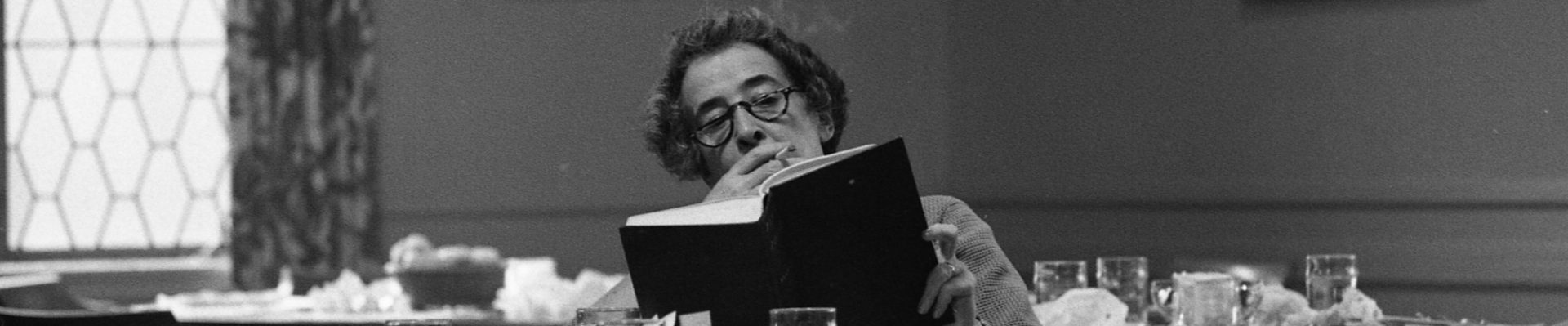
After observing the Adolf Eichmann trial in Jerusalem in 1961, the Jewish philosopher Hannah Arendt came up with the phrase “banality of evil”. In her eyes, Eichmann, one of the key implementers of the ‘Final Solution’, appeared not as some devilish monster, but as a pathetic thoughtless little man.
The evil done by him is the inability to form authentic thoughts beyond the ideological clichés that Eichmann recited time and time again, and the inability to think for himself. This banal evil is limitless, which is how millions of lives can be claimed by it because the spread of this evil does not depend on the involvement of bad people, who genuinely intend to do harm, it is bottomless as it can never be satisfied.
The book Eichmann in Jerusalem. A Report on the Banality of Evil, released in 1963, provokes heated discussions to this day. So much, that the debate regarding the appropriateness of the example of Eichmann to illustrate the thesis of the banality of evil, at times overshadows the new type of evil that we, modern societies, are bound to grapple with.
This evil, being deprived of human moral intent, spreads through politics – through the actions and choices of people occupying otherwise legitimate institutions.
Appeal to protesters’ sense of decency
When peaceful protests erupted last year in Belarus, the police resorted to force and violence. Beatings, torture, arbitrary detention in small cells, where jammed people could not even sit down and were denied basic needs, became the routine.
Nevertheless, when the protesters on the streets seized water cannons, some of these state officers had the audacity to appeal to protesters’ sense of decency, explaining that the lost equipment would have to be paid for by officials’ salaries.
In this moment of state-imposed violence, routinely attacked citizens are asked for empathy. This example offers a good glimpse into the kind of thoughtlessness that Arendt referred to and that the regime of oppression in Belarus relies on. It relies on the incapacity of those in a position of power to see the events from someone else’s perspective. It is the shielding oneself from any thoughts about the impact of one’s actions, that make them possible among many.
This shielding is what Arendt means by thoughtlessness. It enabled Eichmann to sit for months on end facing a Jew who was conducting the police interrogation, pouring out his heart to the man, explaining that it had not been his fault that he did not reach a higher rank in the SS.
When Russia oppositionist Alexey Navalny called one of his alleged poisoners, tricking an operative from Russia’s FSB to disclose details of the crime the same thing was shining through.
Konstantin Kudryavtsev, a trained chemical-weapons specialist, when asked for his personal opinion of Navalny, continues in the same matter-of-fact manner talking about him as a target, pointing out how cautious he is when in public.
Kudryavtsev demonstrates the lack or inability for a personal, autonomous human judgement. His personal opinion is completely interchangeable with the working language of an FSB operative.
Unmasking the angel of death
While we tend to think of these evils as a peril of anti-democratic regimes, what the banality of evil suggests is that without personal responsibility, a simple ability to think about the effect and meaning of our own actions, the monstrous evils spread through institutions regardless of the regime.
The idea was well captured by historian David G. Marwell when talking about another notorious criminal of the Nazi regime. Analysing the life and work of Josef Mengele, he concludes:
”The notion of Mengele as unhinged, driven by demons, and indulging grotesque and sadistic impulses should be replaced by something perhaps even more unsettling. Mengele was, in fact, in the scientific vanguard, enjoying the confidence and mentorship of the leaders in his field. The science he pursued in Auschwitz, to the extent that we can reconstruct it, was not anomalous but rather consistent with research carried out by others in what was considered to be the scientific establishment. That research was criminal – and monstrous – because of the absence of all barriers that ordinarily serve to contain and regulate the temptations and ambitions that can push scientific research across ethical boundaries. Relegating Mengele and his research to the ranks of the anomalous and bizarre is perhaps more palatable than understanding that he was the product – and promise – of a much larger system of thought and practice. It is easier to dismiss an individual monster than to recognise the monstrous that can emerge from otherwise respected and enshrined institutions.”
The support for Donald Trump by many elected officials meant nothing less than the ‘defence of the Republic’ and the ‘restoration of America’. In their heads and hearts, they were serving their country and their people, all the while in the process pushing the institutions they represent beyond ethical, moral and legal boundaries.
As a result, evils emerged from otherwise respected institutions. It is no surprise that the political situation in the United States culminated in a riot and the storming of the Capitol, in the name of the people but under the pretence of talking back the tainted and stolen institutions, because this is the narrative promoted by those representing them.
The culmination of this thoughtlessness is the fact that the Congressmen, who amplified and supported the lie, were forced to evacuate the Capitol, becoming hostages to their own lies and actions.

Pride and enthusiastic participation
One of the most common misconceptions about Arendt’s thesis is that evil is reduced to the almost mechanical actions of a bureaucrat who is obeying orders.
Yet, Arendt notes Eichmann’s enthusiastic participation and even his pride (towards the end of the war he also disobeyed Himmler’s order and continued to organise the death marches of Hungarian Jews).
Hence, she offers to think of Eichmann as a joiner: someone, who rejected the Protocols of Elders of Zion but embraced the oath to the Nazi party and the motherland at any cost. Contemporary joiners, who find themselves in the middle of a movement will accept any sacrifice asked of them, driven by the sense of being in the middle of a great historical moment.
Arguably, a joiner will also eagerly accept and embrace any new conspiracy or a lie, as the sense of belonging and meaning is more important than the content or contradictions of ideas or facts. A joiner is someone who is unwilling to critically reflect on one’s own actions and views, but also will disregard any alternative out of prejudice.
Yet another variation of thoughtlessness is the scandal of József Szájer, a (now former) MEP with Hungary’s ruling Fidesz, who was caught breaking the pandemic rules, while at a gay sex party in Brussels. Szájer is a founding member of Fidesz, a party that built itself up on an ‘illiberal’ type of Christian democracy, in opposition to a liberal, open Europe.
In 2011, Szájer pushed for a highly conservative draft of the constitution that as consequence excludes same-sex couples from the institution of marriage. The hypocrisy was quickly pointed out: a dissonance between actions and words, between private life and public persona.
Situations like these are often explained by pure opportunism, i.e. banking on ideas and programs, that would gather the most votes, despite lack of genuine belief in these ideas.
The banality of evil thesis rather suggests that it is the inability or refusal to have an internal dialogue with oneself, which allows ignoring complete contradictions in one’s actions enabling evil. Without speculating about this gentleman’s private life, a question arises about his urge (or decision) to hide who he is behind a façade.
Is there a possibility that Szájer feels some shame about his own private life? Yet, this shame is politically fueled and manufactured by the policies initiated and implemented by politicians like Szájer in a democratic state. Fueled to the point where entire groups of people feel alienated, threatened and are driven into hiding.
The political crusade against a liberal and anti-Christian future is the kind of evil that is not out of conviction but rather suggests a trait of a joiner, of someone who seems oneself on the right side of history and feels justified in steering the political institutions in its direction at any cost.
Counterbalancing the spread of political evils
The rule of law and the democratic institutions are important, they are designed to counterbalance the spread of political evil and provide checks and balances.
Yet, the story of a voter fraud conspiracy in the US proves that it is the actions of numerous public servants, who insisted on counting votes fairly, following the rules, rather than bending them, that allowed pushing back against the assault on the democratic process.
Who knows how this story would have turned out if the polling stations, courts and local governments were occupied by more joiners.
Democratic institutions can easily be poisoned from within by people who display a disregard for the world around them. In a way, the path to the higher echelons of democracy may also be paved through thoughtlessness.
*Republished here with the permission of the author and Visegrad Insight, where it first appeared: Understanding and Misunderstanding Arendt’s Banality of Evil Today